

Are slip cast ceramics handmade?
A look inside a one-person studio
Every so often someone picks up one of our cups, hears the word "mould," and decides it can't be handmade. If there's a mould, the thinking goes, it must be a factory. It's a fair assumption. It's also wrong, at least for how I work here.
So here's what actually happens.
Where a piece comes from
Every design starts as a drawing. Then a digital model. Then a prototype that gets reworked until the proportions feel right, which usually takes longer than anyone expects. Only once the form is settled do I make a plaster mould by hand, always original to the studio.
Making the mould is its own craft, and it's the part most people never see. A mould is the negative of the piece, so the whole thing has to be worked out in reverse. The shapes the plaster is poured around are 3D printed first, which can take days on its own. Then the plaster has to be mixed and poured at the right moment, without trapping air. Multi-part moulds are poured one part at a time, then demoulded and cleaned up. That takes days too. Where the parts meet has to be judged so the cast releases cleanly. Get an angle wrong and the piece won't come free, or it comes out torn. Porcelain also shrinks by around 15 percent as it dries and fires, so the mould has to be made larger than the finished cup, then tested until it casts true.
Slip is liquid porcelain. It's poured into the mould, left to set to the right thickness, then tipped out and left to firm up. Each piece is trimmed, sponged and finished by hand. It's fired twice, finishing at cone 10 (around 1300°C), glazed on the inside and the rim, with the outside left raw so you can feel the porcelain itself. None of that is automated. None of it is fast.
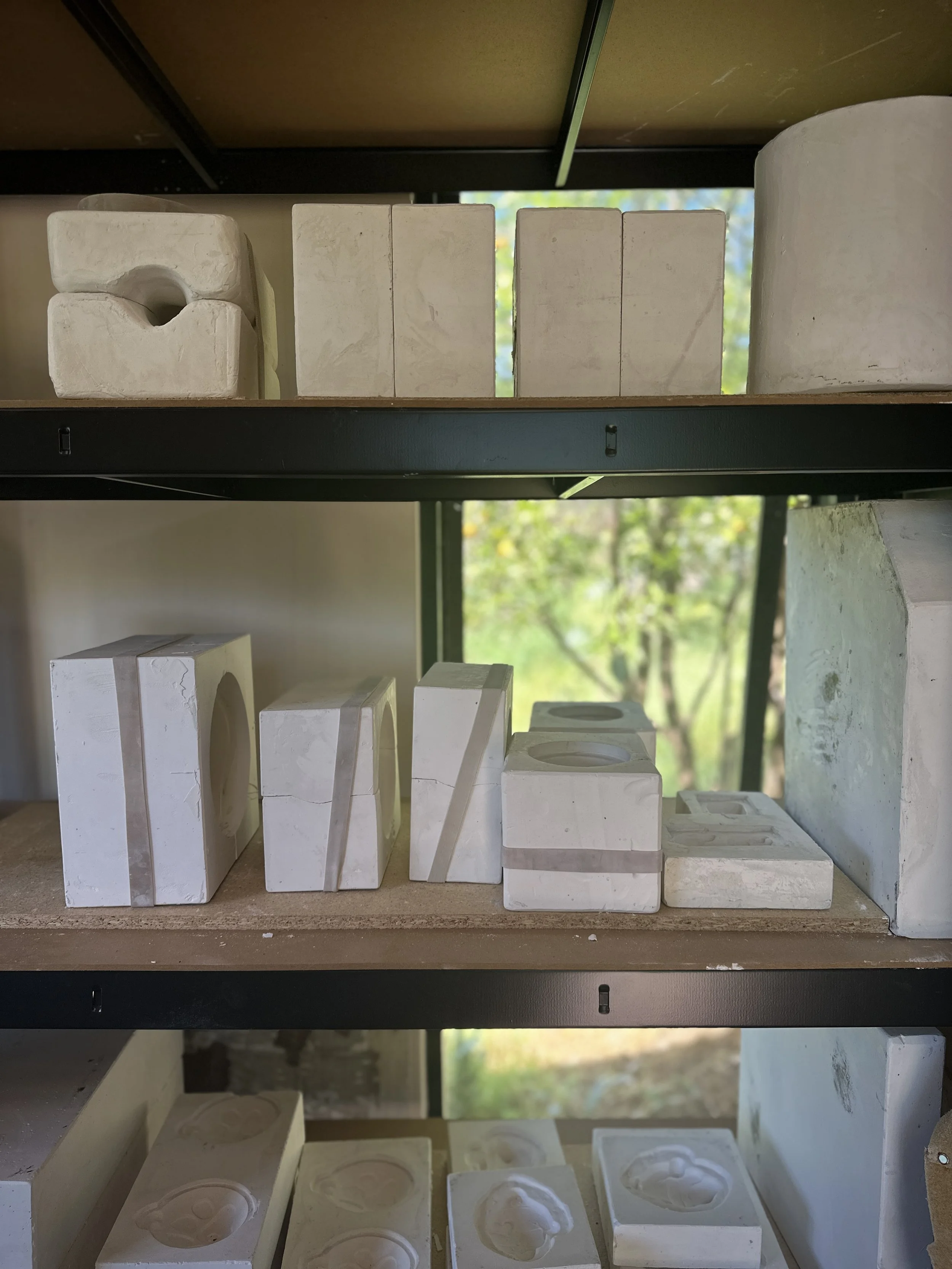
Why "mould" doesn't mean "factory"
Here's the honest part. A mould lets me repeat a form, and that's exactly why I use one. A lot of the design lives in the shape: a particular handle, a wave in the rim, the way the whole thing sits. Those are hard to repeat by hand or on a wheel, where every attempt drifts a little. The mould carries the shape through. It doesn't make the pieces identical. The finishing is still by hand, so no two are exactly the same.
A factory breaks the job into separate steps, often with machines doing some of them. Here it's one person in a small Adelaide studio, working in small batches. Every pour is judged by eye. Pieces crack, warp or don't survive the kiln. That's a normal part of ceramics however it's made. A run of twenty is a different thing to a run of twenty thousand.
What that means if you want something made for you
The mould is the useful part. Because I make every mould myself, a form can be designed around a specific need instead of picking the closest thing from my collection. A cafe that wants a cup that feels right in its customers' hands, with a handle that doesn't dig into the pinky. A table that needs a plate sized for how you actually serve. A set that matches a space.
This is also where I'd rather be honest than sell you something. Custom work takes time. A new form means design, prototyping and a new mould before a single piece is cast, and I fire in batches, so timing depends on where the kiln schedule is. If you need a thousand identical mugs next month, I'm not the right studio. If you want a smaller run of something designed properly and made carefully, we should talk.
Smaller changes are easier. Some pieces can be personalised, a name or a few words on a mug, on a design I already cast.
What to do next
Have a look through the collection to see what the process makes. If you have something in mind, send me a few details: what it's for, roughly how many, and a target budget range. I'll tell you straight whether it's a good fit.
And next time someone tells you slip casting isn't handmade, you'll know what's behind the word "mould."
